About Polycystic Kidney Disease
Polycystic kidney disease (also called PKD) causes numerous cysts to grow in the kidneys. A cyst is a hollow cavity containing a liquid. When too many cysts grow or if the cysts get too large, the functional cells of the kidneys, the neurons, can become damaged. PKD cysts slowly replace the neurons which reduces kidney function and eventually causes kidney failure.

The large somewhat spherical or balloon like spaces in the enlarged kidneys show where the cysts were located.
Signs and symptoms
Most people who have PKD begin to grow cysts when they are children. They do not develop symptoms until they are in their 30’s to 40’s. About 1/4 of PKD patients also have mitral valve prolapse which causes a fluttering sensation or pounding in the chest. Patients might also experience chest pain. These symptoms often resolve on their own.
Another common sign of PKD is hypertension, this may be the first sign of a problem with their kidneys. Occasionally, patients may develop headaches related to high blood pressure. Because high blood pressure can cause kidney damage, it is very important to treat it. In fact, treatment of high blood pressure can help slow or even prevent kidney failure. in patients with PKD. Other common signs of PKD include:
- Back or side pain
- An increase in the size of the abdomen
- Blood in the urine
- Frequent bladder or kidney infections
- High blood pressure
- Fluttering or pounding in the chest
Causes
PKD runs in families. It is an inherited disorder that is passed from parents to children through genes.
Types
Autosomal Dominant Polycystic Kidney Disease (ADPKD):
ADPKD is caused by an abnormality – often called a mutation – in one of two genes involved in ADPKD. These genes are called PKD1 and PKD2. Most people get the disease when they inherit a faulty copy of one of these from a parent with ADPKD. Sometimes, though, a new genetic change occurs spontaneously, causing the disease in a person with healthy parents who do not have the mutated gene. This new mutation can then be passed onto the next generation. You only need to receive one mutated gene copy to have ADPKD. So, a person with the disease has a one in two (50 per cent) chance of passing the disease on to each of their children, depending on whether they pass on their faulty or normal copy of the gene. If a child inherits the normal copy from an affected parent, then they (and any children they go on to have) will not have the disease.
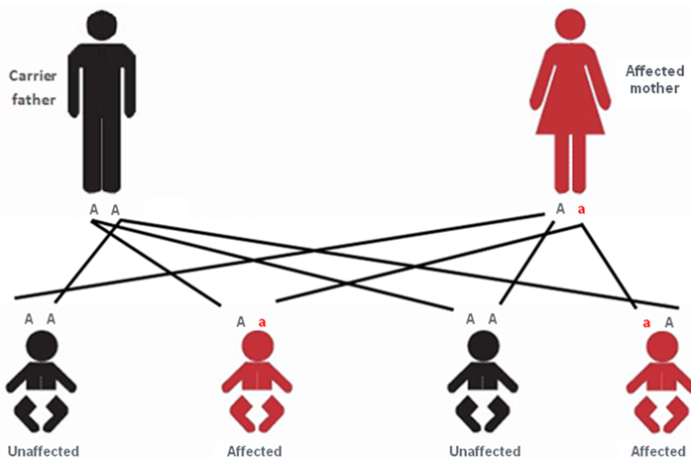
ADPKD is an inherited disease, meaning it is passed on from parents to their children through their genes. Each conception has a 50% chance of having PKD.
Infantile or autosomal recessive (ARPKD)
- Genetic Basis: ADPKD is primarily caused by mutations in two genes—PKD1 and PKD2. The PKD1 gene is located on chromosome 16, while PKD2 is located on chromosome 4.
- Inheritance Pattern: ADPKD follows an autosomal dominant inheritance pattern. This means that an individual only needs to inherit one copy of the mutated gene from either parent to develop the disease. If one parent has ADPKD, each child has a 50% chance of inheriting the mutated gene.
Genetic Basis: ARPKD is primarily caused by mutations in the PKHD1 gene, located on chromosome 6.

Inheritance Pattern: ARPKD follows an autosomal recessive inheritance pattern. Both parents must carry a copy of the mutated gene, and an affected individual must inherit one copy from each parent to develop the disease. If both parents are carriers, there is a 25% chance that each of their children will have ARPKD.
Acquired cystic kidney disease
Also called ACKD
ACKD can happen in kidneys with long-term damage and severe scarring, so it is often associated with kidney failure and dialysis. About 90 percent of people on dialysis for 5 years develop ACKD. As such ACKD is not an inherited disorder. People with ACKD usually seek help because they notice blood in their urine. This is because the cysts bleed into the urinary system, which discolors urine.

Often one or more cysts develop in the kidneys and do not cause issues.
Complications
Individuals with PKD who are concerned about passing the disease to their children may want to consult a genetics counselor to help them with family planning. Many university medical centers have this service.
DISCLAIMER
The Site may contain (or you may be sent through the Site) links to other websites or content belonging to or originating from third parties or links to websites and features in banners or other advertising. Such external links are not investigated, monitored, or checked for accuracy, adequacy, validity, reliability, availability, or completeness by us. WE DO NOT WARRANT, ENDORSE, GUARANTEE, OR ASSUME RESPONSIBILITY FOR THE ACCURACY OR RELIABILITY OF ANY INFORMATION OFFERED BY THIRD-PARTY WEBSITES LINKED THROUGH THE SITE OR ANY WEBSITE OR FEATURE LINKED IN ANY BANNER OR OTHER ADVERTISING. WE WILL NOT BE A PARTY TO OR IN ANY WAY BE RESPONSIBLE FOR MONITORING ANY TRANSACTION BETWEEN YOU AND THIRD-PARTY PROVIDERS OF PRODUCTS OR SERVICES.
PROFESSIONAL DISCLAIMER
The Site cannot and does not contain medical/health advice. The medical/health information is provided for general informational and educational purposes only and is not a substitute for professional advice. Accordingly, before taking any actions based upon such information, we encourage you to consult with the appropriate professionals. We do not provide any kind of medical/health advice. THE USE OR RELIANCE OF ANY INFORMATION CONTAINED ON THE SITE IS SOLELY AT YOUR OWN RISK.
AFFILIATES DISCLAIMER
The Site may contain links to affiliate websites, and we receive an affiliate commission for any purchases made by you on the affiliate website using such links.
We are a participant in the Amazon Services LLC Associates Program, an affiliate advertising program designed to provide a means for us to earn advertising fees by linking to Amazon.com and affiliated websites.
This disclaimer was created using Termly’s Disclaimer Generator.
 Nursing Notes